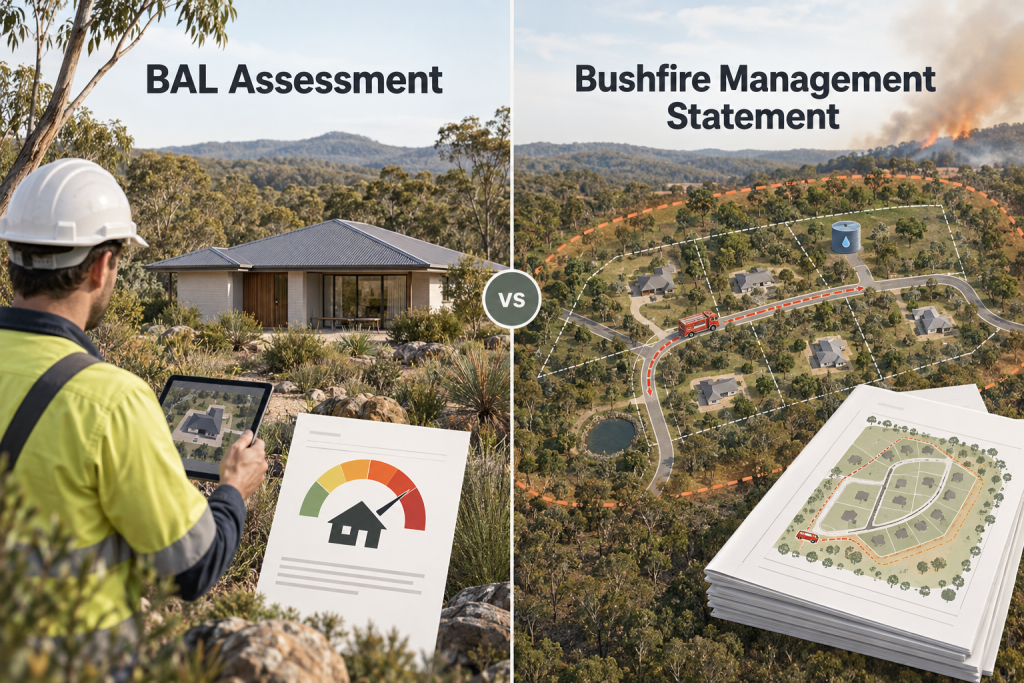
The terms get used almost interchangeably in casual conversation, but a BAL assessment and a Bushfire Management Statement are two different documents doing two different jobs. Mixing them up, or assuming one will satisfy a requirement meant for the other, is a common source of delay at the council stage. One establishes a construction standard. The other examines a much wider picture of risk across a site or a development. We help clients work out which one their project actually needs, and this sets out where the line sits between them.
What a BAL Assessment Actually Establishes
A Bushfire Attack Level assessment is the more common and more narrowly focused of the two documents.
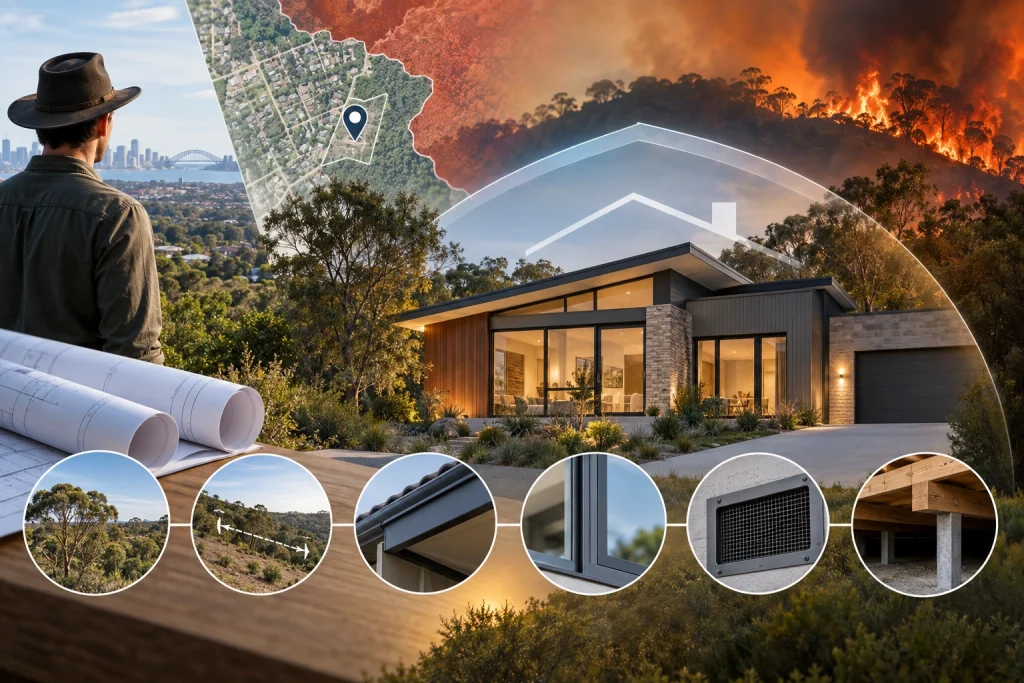
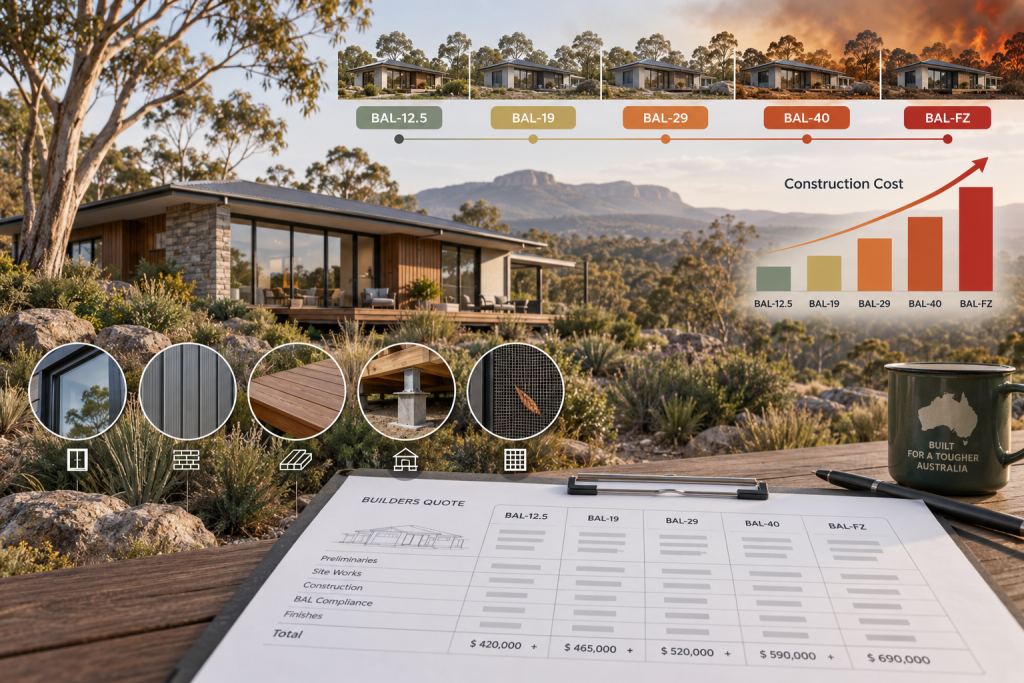
It produces a single rating, from BAL-LOW through to BAL-FZ, based on vegetation classification, distance to that vegetation, and slope.
It’s calculated under Australian Standard AS 3959, using either the simplified or the detailed calculation method depending on site complexity.
The rating feeds directly into construction requirements for the building itself, covering elements like roofing, glazing, decking, and subfloor construction.
It’s generally the document required alongside a standard building permit application for most residential projects.
For a large share of residential builds and renovations on bushfire prone land, this is the only bushfire-related documentation the project needs.
Where a Bushfire Management Statement Goes Further
A Bushfire Management Statement (sometimes called a Bushfire Management Plan depending on the jurisdiction) incorporates a BAL assessment as one component, but it doesn’t stop there. It looks at the broader picture of bushfire risk across a site or a proposed subdivision, addressing factors a standard BAL assessment doesn’t need to touch.
This typically includes asset protection zones and how they’re maintained over time, vehicle access for emergency services, water supply for firefighting purposes, and how the development sits within the wider landscape rather than just the footprint of a single building. It’s a document built around demonstrating that an entire development, not just one dwelling, meets bushfire protection criteria set by the relevant state planning framework.
Because it covers so much more ground, a Bushfire Management Statement takes considerably longer to prepare than a standalone BAL assessment, and it’s reviewed with a correspondingly higher level of scrutiny before council will approve it.
Where Each One Typically Applies
Which document a project needs comes down largely to scale, location, and how the local planning scheme treats the site.
A standard BAL assessment is usually sufficient for single dwellings, smaller renovations, and straightforward residential lots within a mapped bushfire prone area.
A Bushfire Management Statement is more likely to be required for subdivisions, multi-lot developments, or sites where the local council or fire authority identifies a higher overall level of bushfire risk.
Sites landing in the higher BAL categories are more likely to trigger the need for the fuller statement, since these ratings often coincide with the broader risk factors a Bushfire Management Statement is designed to address.
Local government planning schemes vary in exactly where they draw this line, so the same type of project can require different documentation depending on the council involved.
This is one of the reasons two seemingly similar builds in different local government areas can face quite different approval requirements.
Why the Confusion Keeps Coming Up
Part of the mix-up comes from the fact that a Bushfire Management Statement contains a BAL assessment within it, so the two documents aren’t entirely separate, they overlap. Someone who has only ever needed a standalone BAL assessment can reasonably assume that’s all any bushfire-related project requires, right up until a more complex site or a subdivision brings the wider document into play. The other source of confusion is terminology drifting between states and even between councils within the same state, where similar documents carry slightly different names depending on who’s reviewing the application.
The practical upshot is that assuming a BAL assessment will cover everything, without confirming it against the specific site and the local planning scheme, is a good way to end up submitting an application that comes back requesting more.
Knowing Which Document Belongs on Your Desk
The safest way to avoid the confusion is to confirm requirements against the specific site and project type before committing time and budget to either document, rather than assuming a straightforward BAL assessment will cover a more complex proposal. Larger sites, subdivisions, and land carrying higher exposure are the ones most likely to need the fuller statement, and knowing that early feeds directly into how realistic a project’s timeline and budget expectations are from the outset.
We help clients work out early which document their project actually calls for, matching the assessment to the site and the local council’s requirements rather than defaulting to the more involved option. Once you know which rating or statement applies, the next practical question is usually what it means for the numbers on a build. this look at how your BAL rating changes your construction budget picks that up directly, and for the fuller view of how these assessments and statements fit together across different property types, this complete guide to Bushfire Attack Level assessments in Australia brings the whole process together.