Designing energy-efficient homes is as much about strategy as it is about compliance. In Australia, Section J of the National Construction Code (NCC) gives designers and builders two key compliance pathways: Deemed-to-Satisfy (DTS) and the JV3 Performance Solution. While DTS is straightforward, it can also be restrictive and costly in certain design scenarios. JV3, on the other hand, provides flexibility that can translate into real cost savings—without compromising on performance.
At Sustainaspace, we work with both approaches daily, tailoring compliance solutions that meet regulations while unlocking design efficiency. Understanding when JV3 is the smarter choice can help homeowners, architects, and developers achieve both sustainability and affordability.
The Basics: DTS Vs JV3
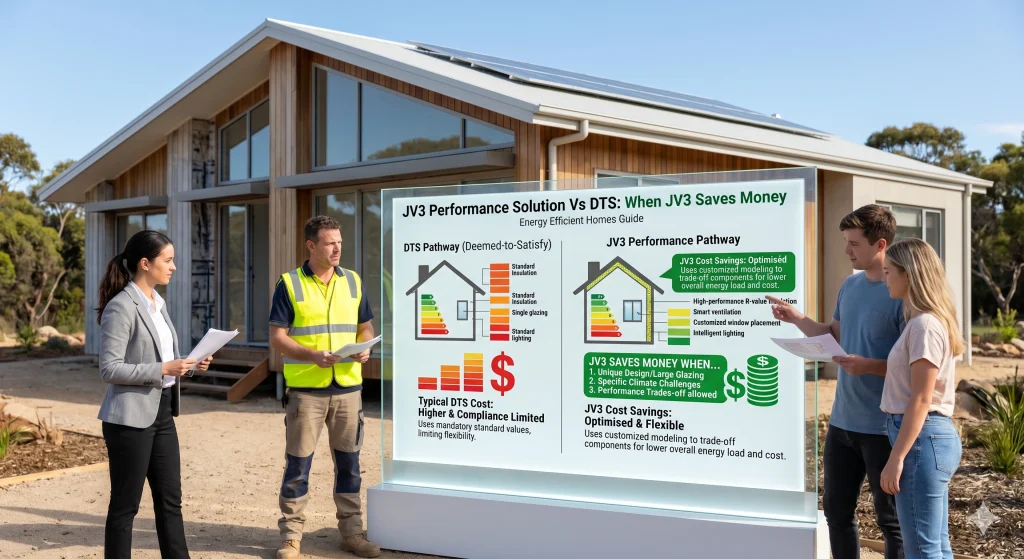
The Deemed-to-Satisfy pathway is prescriptive. It sets specific requirements for insulation levels, glazing performance, shading devices, and other building elements. If your design ticks every box, compliance is granted. However, the rigidity of DTS can often force designers into costly material upgrades or design compromises that don’t necessarily improve comfort or efficiency.
JV3 is different. It’s a performance-based solution that models the entire building in a simulated environment. Instead of checking off prescriptive measures, JV3 demonstrates that the building, as a whole, performs as well as—or better than—the DTS benchmark. This holistic approach allows flexibility in materials, design features, and systems, opening opportunities for cost reduction and smarter resource allocation.
This difference makes JV3 especially useful for unique projects. A design that doesn’t align neatly with the rigid DTS requirements can still show it is highly efficient through careful modelling. It’s a method that rewards creative thinking, architectural freedom, and data-driven decision-making.
When JV3 Works to Your Advantage
JV3 becomes particularly advantageous in designs with complex geometry, large glazing areas, or unique façade treatments. For example, a house with extensive glass walls may struggle under DTS rules due to strict limits on U-values and Solar Heat Gain Coefficients (SHGC). Under JV3, the same glass can remain if other compensating measures—such as efficient HVAC systems or improved insulation in less visible areas—balance the building’s overall energy profile.
This doesn’t just save money on materials; it also preserves the architectural intent of the design. Façade and glazing modelling has already shown that the careful selection of U-values and SHGC can dramatically influence performance outcomes, making JV3 a pathway that supports innovation rather than stifling it.
Another example is in roof design. A sloped or unusual roof may require costly insulation layers under DTS. Through JV3 modelling, the performance of the roof can be offset by measures like tighter window performance or shading improvements, allowing more practical and cost-efficient material selections.
Cost Savings Beyond Materials
The most obvious savings with JV3 often come from avoiding high-performance glazing or oversized insulation that DTS may require. But the financial benefits don’t stop there. By optimising the whole building’s energy balance, JV3 can reduce the size—and therefore the cost—of heating and cooling systems. Smaller plant requirements mean both lower capital expenditure and reduced operational energy bills.
For developers, this can scale significantly. Imagine a multi-unit residential building that under DTS demands top-tier glazing across every window. With JV3, strategic modelling might allow standard glazing in less exposed orientations, reserving higher performance windows only where needed. That difference can amount to hundreds of thousands of dollars saved across the project.
The long-term benefits are just as valuable. A building designed through JV3 doesn’t just comply—it often performs better in real-world conditions. Lower energy use translates into ongoing cost savings for occupants, creating homes that are not only affordable to build but also affordable to live in.
The Role of NCC 2022 in JV3
The NCC 2022 update has placed even greater emphasis on whole-of-building performance, which aligns closely with the principles of JV3. Section J compliance under NCC 2022 has highlighted the importance of integrating NatHERS and ESD considerations at the design stage, ensuring that energy efficiency isn’t treated as an afterthought. JV3 is well positioned in this context, offering a more adaptable pathway for demonstrating compliance with the tightened standards.
One important feature of NCC 2022 is the stronger link between Section J and the Nationwide House Energy Rating Scheme (NatHERS). This makes modelling accuracy even more critical. JV3 naturally complements these requirements by simulating building performance in a way that reflects occupant comfort, thermal bridging, and seasonal variations—factors that prescriptive DTS rules can oversimplify.
By using JV3, design teams can explore innovative solutions such as mixed-mode ventilation, advanced shading strategies, and optimised thermal envelopes—elements that go beyond what prescriptive DTS tables can capture.
Design Flexibility Means Future-Ready Homes
The greatest benefit of JV3 is flexibility. Instead of limiting choices, it allows for trade-offs across the building envelope and systems. Want a larger window for natural light and views? JV3 makes it possible, provided the overall performance meets requirements. Want to experiment with new materials or a bold façade? Modelling can test its impact and identify compensating measures.
As with façade and glazing modelling, JV3 encourages data-driven decision making rather than one-size-fits-all prescriptions. This is critical for future-proofing homes, ensuring they remain efficient, comfortable, and aligned with evolving sustainability goals.
It also provides resilience against changing codes. As sustainability requirements continue to tighten in future versions of the NCC, projects that rely on prescriptive DTS measures may face sudden cost escalations. Homes designed with JV3, however, already demonstrate robust and holistic energy performance, making them better positioned to meet upcoming standards with minimal adjustments.
Building Smart, Saving Smart
Energy-efficient homes are no longer just about compliance—they’re about creating spaces that are livable, sustainable, and cost-effective. JV3 gives us the tools to achieve all three without unnecessary overspend on materials or equipment.
At Sustainaspace, we take pride in guiding clients through these choices, identifying where DTS makes sense and where JV3 can deliver better outcomes. By blending technical modelling with practical building knowledge, we ensure that compliance is not a hurdle but an opportunity to unlock design potential.
In the end, the question isn’t simply “DTS or JV3?” It’s about knowing when JV3 saves money while preserving the vision of the home. And for many projects, that makes all the difference.