At Sustainaspace, we understand that building a truly energy-efficient home starts long before the foundation is poured. Achieving high performance, cost-effectiveness, and regulatory compliance requires a careful understanding of your goals, budget, and environmental responsibilities. Establishing these parameters at the outset ensures that every design choice and construction decision aligns with your vision of a sustainable and comfortable living space.
Defining Your Energy Efficiency Goals
The first step in planning an energy-efficient home is clarifying what efficiency means for you. Are you aiming to reduce your electricity bills, achieve a low-carbon footprint, or exceed local sustainability standards? Understanding your priorities will guide material selection, orientation, insulation levels, and mechanical systems.
Some homeowners focus on passive strategies, such as optimizing natural light and ventilation, while others may prioritize active systems like solar panels, heat pumps, and energy recovery ventilators. Balancing passive and active approaches can yield the best results, and identifying your primary objectives early helps prevent unnecessary expenses or design compromises down the line.
Integrating goals with practical savings strategies resonates with the concepts outlined in the ESD Consultant Guide: Value Engineering: Saving Costs Without Losing Performance — Section J Report, where careful planning ensures efficiency without overspending.
Establishing a Realistic Budget
Budgeting is often the most critical factor that dictates the feasibility of sustainable features in a home. Energy-efficient technologies and materials can sometimes carry higher upfront costs, but when weighed against long-term savings on utilities and maintenance, they typically offer excellent returns on investment.
A comprehensive budget should account not only for construction costs but also for potential design consulting fees, approvals, and any sustainability certifications. It’s essential to allocate a portion of your budget to flexibility, as achieving high energy efficiency may require iterative adjustments to design or material choices. Understanding cost drivers early also allows for targeted value engineering without compromising performance.
A clear budget framework aligns with insights found in BASIX Guide: Sustainable Design Consultation — What You Get & How It Works — Nathers, ESD, emphasizing the importance of balancing compliance and cost effectiveness.
Understanding Regulatory Compliance Requirements
Compliance with local and national energy efficiency standards is non-negotiable in sustainable building. Requirements can include building envelope performance, minimum insulation R-values, thermal bridging controls, energy-efficient glazing, and ventilation standards.
In many regions, frameworks like BASIX in New South Wales or Section J in Victoria enforce strict energy performance metrics. Meeting these standards not only ensures legal approval but also guarantees that your home will perform efficiently under local climate conditions. Engaging early with your ESD consultant or energy assessor helps clarify which regulations are relevant and what documentation is needed for approval.
Early integration of compliance targets mirrors the practical approach highlighted in ESD-focused guides, where precise planning mitigates costly revisions later in the project.
Clarifying Lifestyle and Functional Needs
Energy efficiency must coexist with the practical needs and lifestyle of your household. Consider how space will be used, occupancy patterns, and equipment loads. For example, a family home with multiple occupants may benefit more from high-efficiency water heating systems and zoned heating/cooling than a single-occupant apartment.
Identifying lifestyle patterns also informs passive design strategies. Orientation of living spaces, window placement, and shading devices can dramatically impact comfort while reducing energy demand. Cross-ventilation and daylight optimization not only enhance occupant well-being but also support lower reliance on artificial lighting and mechanical cooling systems.
Prioritizing Key Sustainability Features
Once goals, budget, and lifestyle factors are defined, prioritizing sustainability features becomes more straightforward. Key elements to consider include:
- Building Envelope Efficiency: High-performance insulation, thermal breaks, and airtightness minimize energy loss.
- Renewable Energy Systems: Solar PV panels, battery storage, and hybrid heating systems reduce reliance on grid electricity.
- Water Efficiency: Rainwater harvesting, low-flow fixtures, and greywater systems support responsible water use.
- Indoor Environmental Quality: Ventilation, daylighting, and low-VOC materials enhance health and comfort.
- Smart Controls: Automated shading, lighting, and energy monitoring systems optimize operational efficiency.
Prioritization allows you to focus resources on features that deliver the highest impact for your specific site, climate, and household needs.
Documenting Decisions and Preparing for Consultation
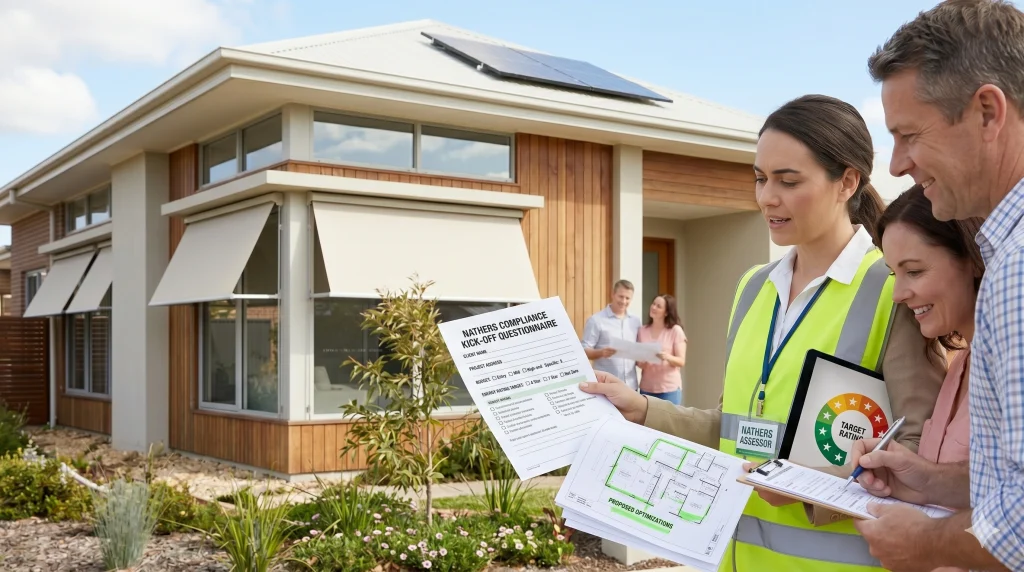
A well-prepared kick-off questionnaire or briefing document for your builder or ESD consultant can streamline the entire design process. Include your energy efficiency goals, budget range, compliance considerations, lifestyle needs, and preferred sustainability features. Clear documentation facilitates accurate cost estimation, reduces the risk of miscommunication, and sets measurable benchmarks for performance.
Structured documentation at this stage reflects the methodology in detailed energy assessment reports, reinforcing the benefits of clarity and planning in achieving high-performance sustainable homes.
Laying the Foundation for Smart, Sustainable Living
Energy-efficient homes are the result of intentional planning, informed decisions, and adherence to both regulatory and personal goals. At Sustainaspace, we guide homeowners through this critical kick-off stage, ensuring that every aspect of the project—from budget allocation to lifestyle compatibility—is considered before a single brick is laid. By aligning energy efficiency targets, compliance requirements, and sustainability priorities early, you set the stage for a home that is not only environmentally responsible but also comfortable and cost-effective for decades to come.