Not every build needs a Bushfire Attack Level assessment, but far more situations call for one than most people expect. It’s not limited to new homes going up on the edge of a forest. Renovations, subdivisions, insurance conversations, and even land purchases can all bring the requirement into play, often at a point in the process when nobody’s thinking to check. We field this question constantly from clients across Perth and Sydney, and this sets out the situations where an assessment stops being optional.
The Situations That Almost Always Trigger One
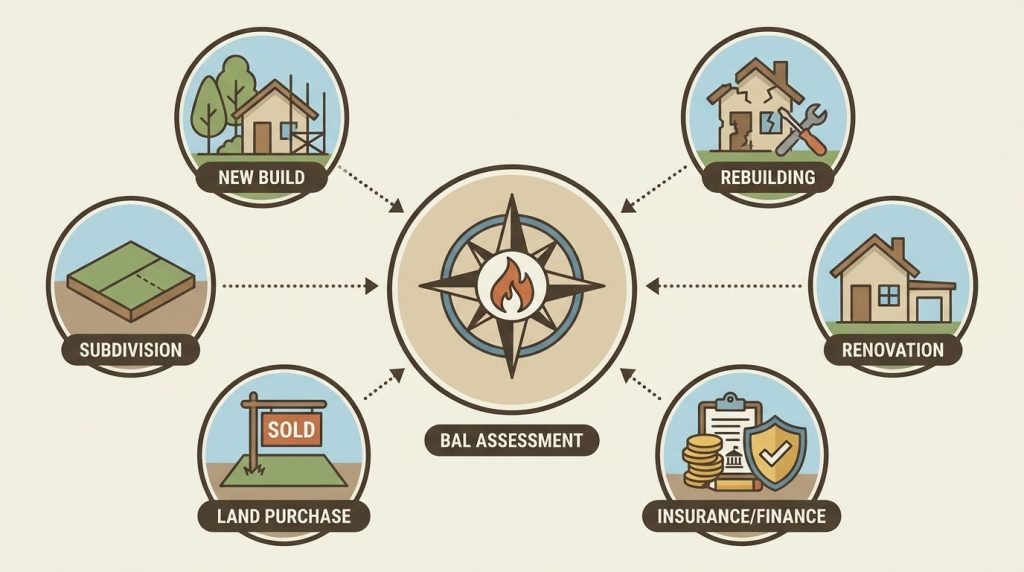
A handful of scenarios reliably bring a BAL requirement into a project, and they’re worth checking against early rather than discovering partway through a development application.
A new dwelling on land within a mapped bushfire prone area. Any residential development application on flagged land needs a rating attached before council or a private certifier will assess it.
Subdividing land that sits inside a bushfire prone zone. New lots created from mapped land typically need their own assessment, since each resulting block can carry a different exposure profile.
Rebuilding after fire or storm damage. Reconstruction on a mapped site is generally treated the same as new construction for approval purposes, even if the original dwelling predates current bushfire provisions.
Adding habitable rooms or extending a footprint significantly. Substantial additions can shift a building’s exposure or bring a previously unrated structure under scope for the first time.
Each of these sits squarely within what most planning departments expect to see accompanying an application, and skipping the step tends to stall approval rather than avoid it.
Why Renovations Catch People Off Guard
Of the situations above, renovations are the one that surprises the most homeowners. A modest extension, like adding a bedroom or enclosing a verandah, can feel like a minor project compared to building a whole new house, but if it increases the building’s footprint or habitable area on mapped land, it can trigger the same assessment requirement as new construction.
This becomes particularly relevant on older properties, since many were built before current bushfire provisions applied, meaning there’s no existing BAL rating on file to reference. A renovation on one of these properties often means starting the assessment process from scratch, which is worth factoring into both budget and timeline well before council submission.
The Situations People Often Miss
Beyond the more obvious triggers, there are a few scenarios that catch buyers and owners less familiar with the process off guard.
Purchasing land that’s already flagged on a bushfire prone area map. Buyers sometimes only discover the requirement after settlement, when it should ideally be checked during due diligence.
Insurance or finance requests. Some lenders and insurers ask for a current BAL rating as part of underwriting, particularly for properties in higher-risk regions, even outside of a formal development application.
A council-requested reassessment. If plans change significantly after an initial rating was obtained, or if enough time has passed and surrounding vegetation has changed, councils can request an updated assessment before approving a project.
These situations tend not to come with the same clear signposting as a standard development application, which is exactly why they’re the ones most likely to be missed until they hold up a settlement, a loan, or a permit.
What Happens If the Requirement Gets Skipped
Ignoring a BAL requirement, whether by oversight or assumption, tends to cause delays rather than savings. Development applications missing the required assessment are typically returned or paused until the documentation is provided, pushing out approval timelines that are often already tight. On the finance side, lenders or insurers requesting a rating that hasn’t been obtained can hold up settlement or cover, which becomes a considerably more stressful conversation mid-transaction than it would be earlier in the process.
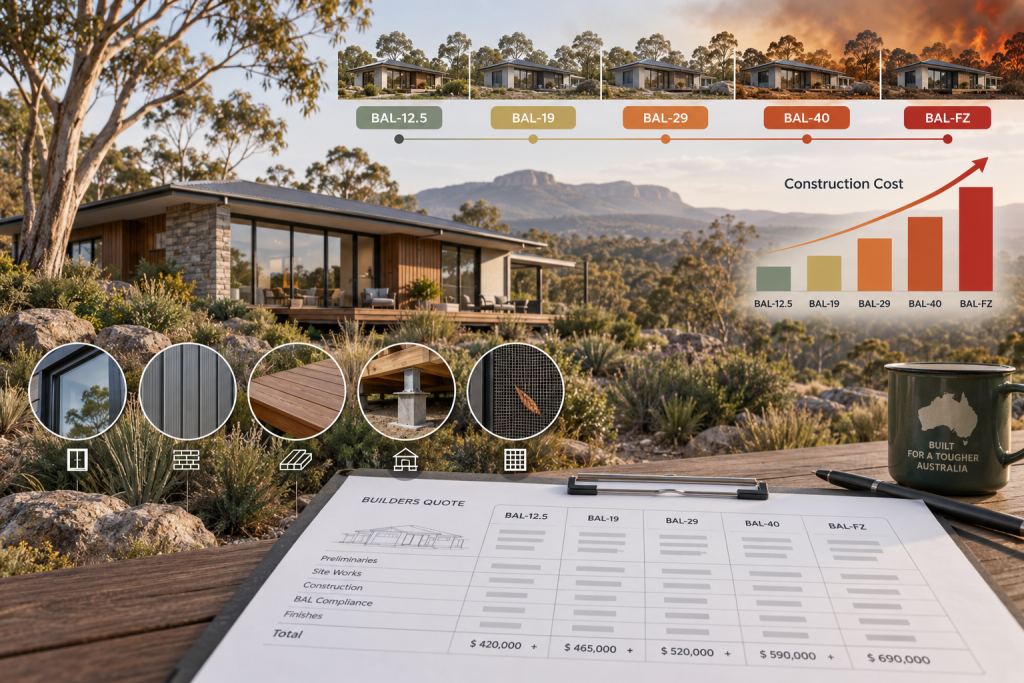
There’s also a practical design cost to skipping it. Construction plans drawn up without knowing the applicable BAL category run the risk of needing rework once the rating comes back, particularly if the final classification calls for different glazing, cladding, or subfloor detailing than what was originally specified.
Working Out Where You Stand
The simplest way to know whether a project needs an assessment is to check the property against the relevant state bushfire prone area mapping as early as possible, ideally before a development application is drafted or an offer on land is finalised. From there, the type of project (new build, renovation, subdivision, or reconstruction) determines exactly what documentation is required and how it fits into the broader approval pathway.
We work through these situations with clients regularly, checking a property early enough that the answer feeds into design and budgeting rather than arriving as a late surprise. If your project sits in Western Australia, this walkthrough of the WA approval pathway for building in a bushfire prone area outlines what comes next once a rating is confirmed, and for the broader view of how these assessments work across different situations, this complete guide to Bushfire Attack Level assessments in Australia brings the full process together.