Designing a sustainable home in Australia requires balancing comfort, compliance, and long-term efficiency. Meeting BASIX water and energy targets is central to this process, and it often comes down to correctly sizing solar PV systems, hot water setups, and rainwater tanks. At Sustainaspace, we approach these challenges with a focus on precision and practicality, ensuring every home we work on is future-ready, compliant, and environmentally responsible.
Understanding BASIX Water and Energy Targets
The Building Sustainability Index (BASIX) sets minimum performance standards for new homes and significant renovations in New South Wales. To gain approval, projects must meet water efficiency and energy reduction benchmarks, alongside thermal comfort requirements.
Water targets ensure households reduce potable water consumption, while energy targets focus on lowering greenhouse gas emissions from everyday use. Meeting these criteria often means designing with solar photovoltaic (PV) systems, efficient hot water solutions, and rainwater tanks. Failing to address these areas in detail is one of the most common reasons BASIX applications stumble, as seen in the way oversight often leads to non-compliance with system capacity and integration.
Sizing Solar PV Systems for BASIX Compliance
Photovoltaic systems are one of the most effective strategies for lowering household energy demand. BASIX credits solar PV capacity based on its ability to offset grid electricity usage. The correct size depends on roof orientation, shading, and expected household consumption patterns.
A common mistake is assuming that bigger is always better. Oversized systems may not be cost-effective, while undersized systems fail to provide sufficient energy reduction for compliance. Generally, households should consider systems in the 3–6 kW range, but BASIX modeling assesses outcomes based on performance, not just raw size.
To optimise, design teams should map out annual energy profiles, factor in peak usage times, and ensure roof space can accommodate future expansion if required. The same attention to detail is essential across other BASIX requirements—poor planning during the design stage is frequently cited as a hidden reason for compliance failure, even when sustainable features are included.
Hot Water Systems: Choosing the Right Setup
Hot water heating is often the single largest energy load in a household, making system choice crucial under BASIX. Options typically include:
- Solar hot water systems with either gas or electric boosting.
- Heat pump systems that efficiently draw energy from the air.
- High-efficiency gas systems for smaller properties where solar or heat pumps may not be viable.
Sizing depends on household size, number of bathrooms, and expected daily hot water demand. A solar system that is too small may require frequent boosting, undermining BASIX energy targets, while a system too large can become inefficient.
For many ecohomes, solar hot water remains the preferred choice due to its strong BASIX credit contribution, particularly when paired with PV systems. Designers must also consider placement for maximum solar exposure and integration with rainwater tanks if dual use is required.
Rainwater Tanks: Storage, Sizing, and Usage
Rainwater tanks play a pivotal role in achieving BASIX water targets. The NSW Government requires new homes to integrate rainwater harvesting for toilets, laundry, and outdoor use. Correct sizing depends on roof catchment area, rainfall patterns, and projected household consumption.
For compliance, tanks typically range between 3,000–5,000 litres. However, bigger tanks may not always mean better performance. What matters is ensuring the tank size matches roof runoff potential and household demand. Tanks that are too large without sufficient collection area risk staying underutilised.
To estimate sizing, designers often apply a simple calculation:
- Roof area (m²) × annual rainfall (mm) × collection efficiency (0.8–0.9) gives the potential annual yield. For example, a 150 m² roof in Sydney with 1,200 mm rainfall could collect around 162,000 litres per year. From there, daily household demand for toilet flushing, laundry, and irrigation can be measured against storage capacity to select an appropriate tank size.
Integrating tanks with automated pump systems maximises efficiency by ensuring rainwater is prioritised before mains supply. Linking tanks to irrigation systems also provides additional credits under BASIX. Design oversight—such as failing to connect tanks to required fixtures—is another frequent reason why BASIX approvals falter, even when the tanks themselves meet size specifications.
Balancing Systems for Optimised Compliance
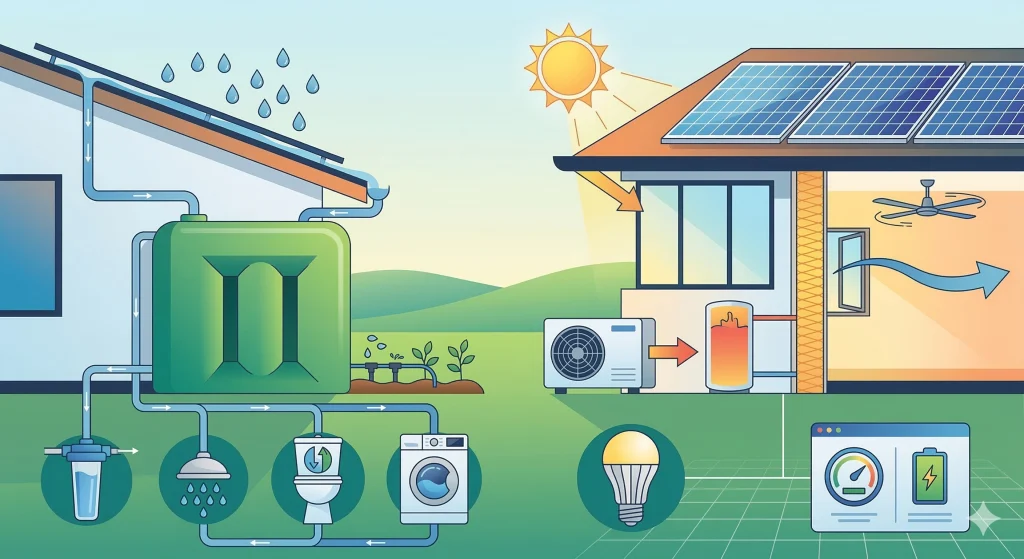
The key to meeting BASIX water and energy targets is not treating PV systems, hot water setups, and rainwater tanks as standalone items. Instead, they must be designed as an integrated system.
For example, a well-sized solar PV system can offset the electricity demand of a heat pump hot water system, creating a balanced load profile. Similarly, a solar hot water system combined with PV ensures excess midday generation is directly utilised, rather than exported to the grid.
Rainwater tanks, meanwhile, reduce mains water demand and complement water-efficient appliances. A 4,000-litre tank connected to toilets and laundry can save up to 40% of potable water use annually, and when matched with low-flow fixtures, the combined savings can make the difference between compliance and failure.
This balancing act also extends to futureproofing. If homeowners plan to add more occupants, appliances, or irrigation needs later, designing flexible systems—like PV-ready inverters or modular tanks—avoids retrofitting costs. The long-term value lies not only in compliance but also in resilience to rising energy costs, water scarcity, and stricter sustainability standards in the future.
Designing for the Future
Sustainable housing is not just about compliance—it is about building homes that remain efficient, comfortable, and cost-effective for decades. BASIX sets the baseline, but thoughtful system sizing ensures every component delivers measurable benefits.
At Sustainaspace, we see BASIX as an opportunity to design smarter. By carefully sizing PV systems, hot water setups, and rainwater tanks, we help create homes that are both environmentally responsible and tailored to the unique needs of their residents. Sustainable design is not about adding features for compliance, but about crafting an ecohome where every element works in harmony.