Why Documentation Matters in Section J and JV3 Compliance
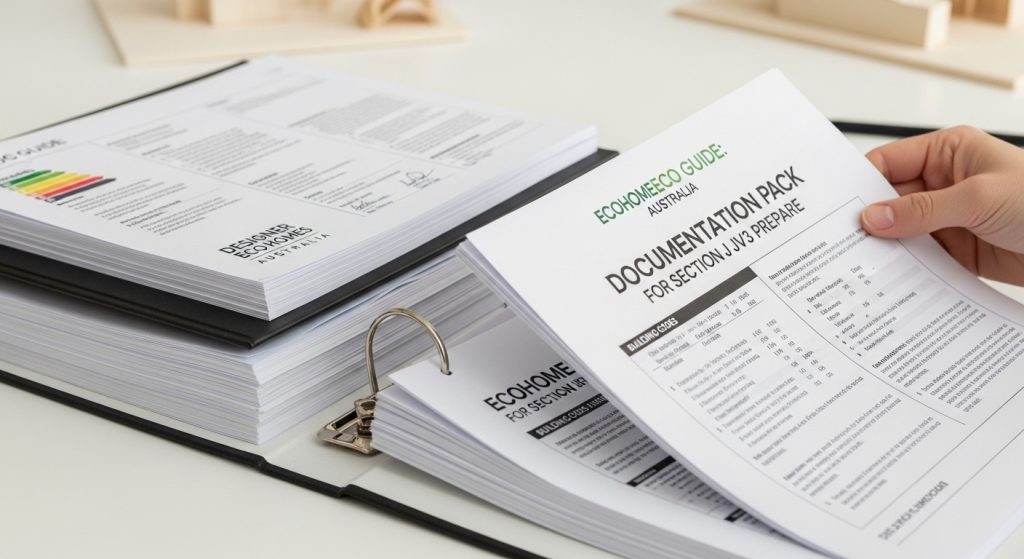
When it comes to commercial building approvals in Australia, energy efficiency compliance isn’t just about design—it’s about documentation. Section J of the National Construction Code (NCC) requires detailed records that demonstrate compliance with the energy efficiency provisions. For projects pursuing the JV3 Performance Solution, the documentation becomes even more comprehensive, as every energy-related element of the design must be modelled and justified against a DTS (Deemed-to-Satisfy) reference building.
At Sustainaspace, we’ve seen firsthand that inadequate documentation is one of the most common causes of project delays. Councils and certifiers demand a clear, well-prepared compliance pack, and failing to supply the right evidence can mean weeks of unnecessary back-and-forth. Preparing your documentation early, and in full, is critical.
The Core Components of a Section J Report Pack
Every Section J documentation pack needs to establish compliance across multiple categories of a building’s energy performance. This begins with the building fabric, where insulation levels and thermal bridging must be accounted for in wall and roof constructions. Glazing details then take centre stage, with U-values and SHGC ratings forming the backbone of performance evidence. Councils will also look for attention to thermal breaks in aluminium framing, which is a common area of oversight.
Beyond this, documentation needs to outline how the building will achieve effective sealing. Information on door seals, air leakage testing, and airtightness strategies all demonstrate that the building won’t waste heating or cooling energy through uncontrolled drafts. Lighting and power records are equally important, requiring calculations that demonstrate compliance with lighting density requirements, as well as details of automatic controls and sensor systems. HVAC and mechanical system information, from efficiency ratings to zoning strategies, must also be supplied, together with evidence of hot water systems, renewables integration, and overall distribution efficiency. All these aspects need to be backed up by specification sheets, annotated drawings, and sometimes manufacturer certifications.
Additional Layers for JV3 Documentation
While DTS reports are largely checklist-driven, JV3 submissions demand a much higher level of justification. Instead of simply showing compliance through prescriptive requirements, a JV3 assessment compares the proposed building’s annual energy consumption against a reference building model. To make this comparison valid, your documentation must include a fully modelled 3D representation of the building, complete with assumptions for occupancy patterns, lighting loads, HVAC usage, and equipment demand.
The materials chosen for walls, roofs, and glazing require verified thermal performance data to support the modelling assumptions. Climate data relevant to the building’s location must also be clearly stated, as this drives much of the projected energy use. Ultimately, councils expect the modelling output to be transparent and traceable. If a proposed glazing system claims a certain U-value, the report should show exactly where that figure comes from, ideally with a manufacturer’s certificate or a recognised calculation report.
What Councils Expect to See
When assessing compliance, councils are not satisfied with the summary report alone. They expect the entire evidence trail to be available. This means architectural drawings must be annotated to show insulation locations and thicknesses, while glazing schedules should list product codes, dimensions, and certified performance values. For HVAC systems, documentation should provide efficiency ratings, coefficients of performance, or energy efficiency ratios, depending on the system type. Lighting schedules need to demonstrate not only wattage but also the presence of control systems and compliance with power density requirements. Where possible, certificates of conformity or accredited test reports should be included.
This level of transparency is especially important in large-volume spaces, such as warehouses and sheds, where lighting and HVAC can make or break compliance outcomes. Without sufficient evidence, councils may request resubmission, delaying construction timelines and potentially inflating costs.
Practical Steps to Streamline Documentation
Although the amount of paperwork can seem overwhelming, there are practical ways to simplify the process. One of the most effective steps is early engagement between designers, engineers, and energy assessors. When everyone involved understands the compliance requirements at the beginning of the project, the documentation can be developed in parallel with the design rather than as an afterthought.
Maintaining a centralised digital file for specifications, drawings, and reports reduces the risk of missing documents during submission. Consistency across documents is also vital—if the architectural drawings and energy report specify different glazing products, councils will pick up on the discrepancy immediately. Using verified manufacturer datasheets wherever possible adds authority to the pack, removing doubt about whether certain values are reliable.
For projects targeting cost-efficient builds, such as industrial sheds, aligning documentation early has proven one of the simplest ways to avoid redesigns and cost overruns. Even a small oversight, like leaving out a manufacturer datasheet for insulation, can trigger additional requests and extend the approval timeline.
The Overlooked Benefits of a Strong Documentation Pack
A complete Section J or JV3 documentation pack offers benefits far beyond the immediate compliance requirement. Developers can move forward with confidence, knowing that the building’s performance has been properly assessed and verified. Tenants and building owners reap the rewards through reduced operating costs, while councils benefit from a more efficient approval process.
This is particularly evident in developments where Section J compliance intersects with affordability goals—such as in large-scale shed or warehouse projects—where clear reporting has allowed developers to avoid unnecessary compliance upgrades while still meeting performance standards. By embedding documentation into the design process itself, project teams can often identify opportunities for cost savings while simultaneously improving long-term sustainability outcomes.
Building with Certainty
Preparing a documentation pack for Section J or JV3 compliance isn’t just about ticking boxes. It’s about providing a transparent, evidence-based story of how a building is designed for efficiency. At Sustainaspace, we believe that the smoother the compliance journey, the sooner sustainable buildings can move from concept to reality. By treating documentation with the same care as design, builders, architects, and developers give themselves—and the community—greater certainty in achieving energy-efficient outcomes.